I am an Arsenal fan, not a bandwagon. A hard core Gooner (Gooners are what Arsenal fans are called, ya nasty). And recently, we could have won the UEFA Champions League Final for the first time, but as the final minutes dwindled down I knew if we went into a penalty shootout, we were DOOMED. Why? Paris Saint-German, our opponents, were statistically superior at taking penalties than we were. Now this isn't a story about a game Arsenal should or shouldn't have won. It is an empirical investigation into why penalty shootouts are so uniquely cruel, frustrating, and psychologically devastating for both the kicker and the fans watching through squeezed fingers.
As a fan, I always find myself saying, "I could have made that," but could I?
On paper, a penalty is a mathematical layup: a stationary ball, 12 yards out, facing an 8-foot-by-24-foot net. In open play, top professionals convert around 80% of their spot-kicks.
You take the ball from the ref, place the ball on the spot, kiss it, do whatever your ritual is. Take your paces back, breath in, and tell yourself you have a 50% chance of making this goal for your team....You run up to the ball and then shit hits the fan, you see the goalie moving, the crowd is yelling, this could be the game winner...and you completly bottle it.
To understand what happens in that split second, I analyzed every single World Cup penalty shootout attempt from 1982 through 2022.
The Spatial Tax: Mapping the 9-Square Grid
+--------+--------+--------+
|   1    |   2    |   3    |
+--------+--------+--------+ Take the 8ft x 24ft goal
|   4    |   5    |   6    | and divide it into a
+--------+--------+--------+ 3x3 grid.
|   7    |   8    |   9    |
+--------+--------+--------+
To get good at something, athletes are told to practice to perfection, with penalty kicks players are often taught to divide the goal into a 3x3 grid and pick a corner. This is also how goalkeepers determine where to dive, they might have a "cheatsheet" on their bottle that says "Player 1 has shot 83% of their career penalties in zone 1." If I want to be "guaranteed" a goal when I walk up to the PK spot, the data shows there is a clear geographical hierarchy to the net.
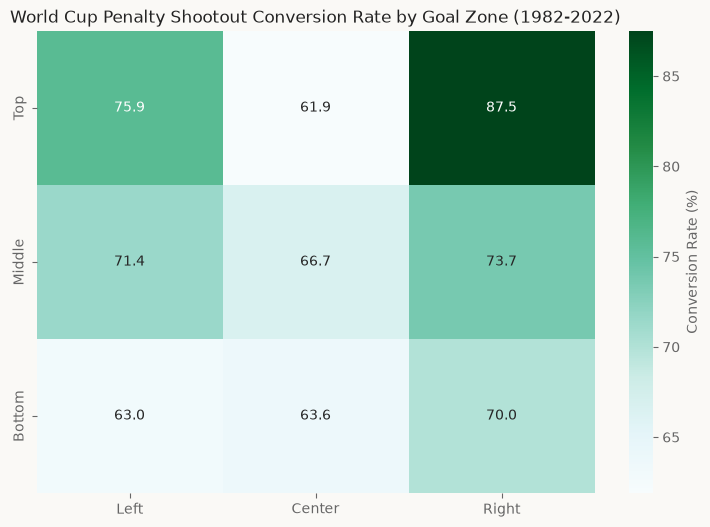
A penalty goal frame is not created equal. Across four decades of World Cup shootouts, placement toward the lateral extremes,specifically the top corners, proves far more lethal than aiming low or central. The 87.5% conversion rate in the top-right quadrant highlights how difficult it is for a keeper to extend high and across their body in time. Conversely, central attempts carry a heavy tax: shooting straight down the middle yields the lowest success rates on the board (~62–67%), as any keeper who holds their ground effectively gets an effortless save.
It is worth noting that shooting down the center statistically gives a higher success rate than shooting in the corners. Based on the data a keeper dived either left or right 88.4% (283/320 dives) of the time and stayed in the center 11.6% (37/320 dives) of the time. However, the psychological pressure of shooting down the middle and looking like a complete fool when the keeper doesn't even have to move to save the shot is a humiliation ritual no kicker wants to risk. (I'll go deeper into this later.)
The Anatomy of Error: Goals vs Saves and Misses
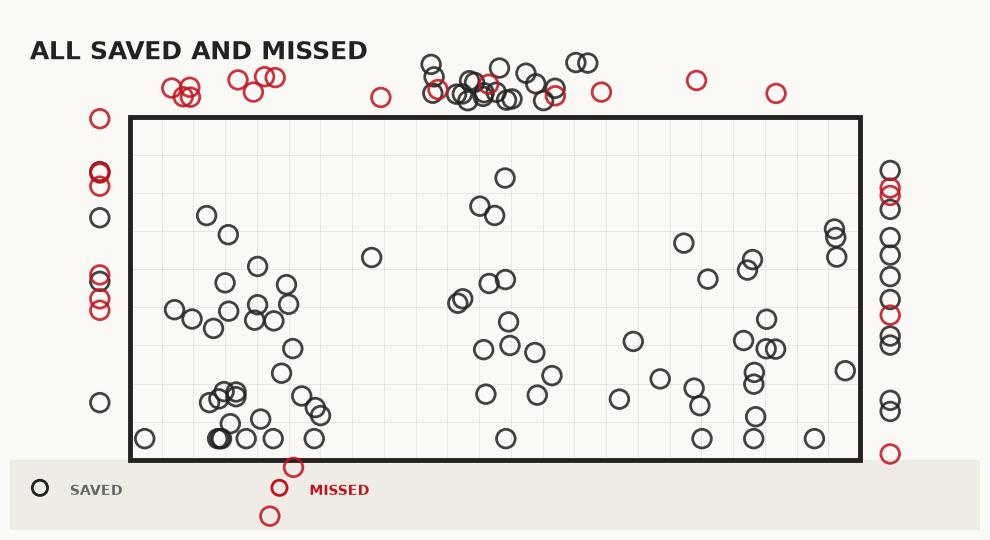
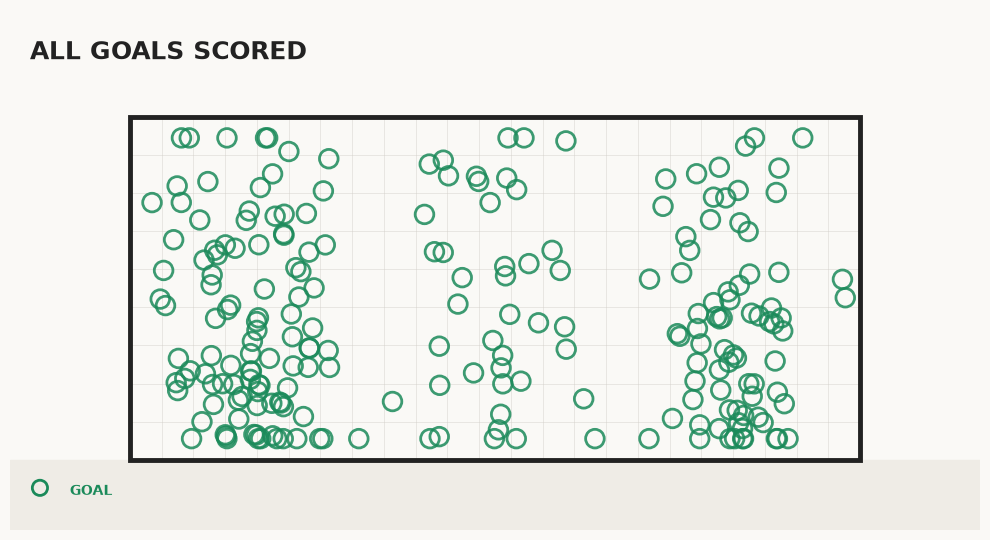
Breaking down all penalty shootout kicks, you can see the trade-off pattern between power, placement, and human error. If you watch any soccer game you will see that modern goalkeepers rarely react to the ball post-contact, they commit to a side early based on their pre-match kicker study guide and body language cues (i.e. if you watch closely you can tell when a left-foot dominant player is wanting to slot it bottom right).
| Saved/Missed |
|---|
 |
| All Saved and Missed PKs |
| Scored |
|---|
 |
| All Scored PKs |
Comparing these two spatial maps reveals the mechanical reality of shootout failures:
1) The "Keeper Comfort Zone": Looking at the Saved and Missed plot, notice how saved shots (dark grey circles) cluster heavily in the mid-height zones between the center and the posts. A shot hit at medium height without extreme corner placement falls directly into a diving keeper's natural reach.
2) The Price of Precision: Notice where the missed shots (red circles) end up. They do not sit inside the net, they instead hug the outside edge of the vertical posts or float over the crossbar. When kickers try to aim away from the keeper's reach to hit that high-value 87.5% top corner, the failure mode shifts from saved to missed entirely. A good example of this is Gabriel Magalhaes' PK miss in that Champions League final.
Game Theory at 12 Yards: The Footedness Paradox
Because goalies know that players prefer natural cross-body power angles (a right-footed player shooting to the keeper's right, or a left-footed player shooting to the keeper's left), the interaction now becomes a live game theory match. Neither party can afford to be predictable.
- From the kicker's point of view if their shot is predictable, the goal will be saved, meaning no goal.
- From the keeper's point of view if their dive is predictable, the ball will go into the net, meaning no save.
When I cross-tabulated the conversion rates based on kicker footedness and goalkeeper dive direction across World Cup history, an exploit emerges:
| Kicker Foot | Keeper Left | Keeper Center | Keeper Right |
|---|---|---|---|
| Left-Foot Taker | 66.7% | 80.0% | 65.6% |
| Right-Foot Taker | 69.0% | 75.0% | 68.4% |
Shooting straight down the middle yields the HIGHEST statistical success for both groups: 80.0% for lefties and 75% for righties.
In that case, why don't players either smash it or chip it right down the center?
Simple. Two words, asymmetric embarrassment. If a player shoots for a corner and the keeper dives and saves it, the fans would be upset but will be content with the fact that the keeper saved it. But if a player shoots straight down the middle and the keeper holds their ground, the player looks dumb as all hell chipping a gentle pass right in the keeper's arms. Even at the highest level of professional sports, human beings actively avoid decisions that carry a high social risk if there is a risk of failure. The math favors the center but the human brain fears the social cost of standing out.
The Pressure Tax: Elimination vs Standard Kicks
Beyond target selection there is a huge psychological toll in the moment itself.
| Standard Kick (non-elimination) | High Pressure (elimination kick) | |
|---|---|---|
| Conversion Rate (%) | 69.3 | 67.4 |
Popular lore suggests that elimination penalties cause world-class players to unravel completely, a good example is Spain as they have the worst World Cup shootout record. But the empirical reality across four decades of World Cup history is more subtle, but statistically revealing. Conversion rates drop by ~2 percentage points when a player faces a "must-score" or "must-save" scenario.
While not a catastrophic collapse, this small margin under extreme psychological stress represents the true cost of elimination pressure, a moment where even elite international players experience a measurable dip in execution efficiency.
Front-Loading and Order Decay
The psychological strain doesn't remain static as the shootout goes on, it compounds with every round. This has to do with the added pressure as each and every round concludes. Most of the time managers almost universally front-load their order, as usually the first three slots are given to the most reliable shooters.
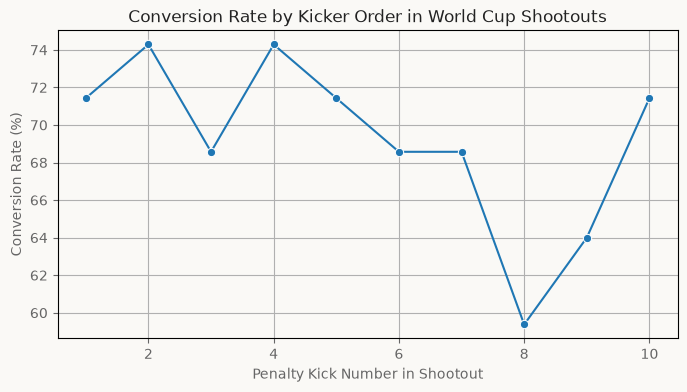
By the time the shootout reaches the 5th or 6th kickers, two things happen simultaneously:
1) The pool of specialists dries up. Most of the time you are no longer watching designated penalty takers, you are watching fatigued center-backs and young wingers and maybe event the goalie.
2) Fatigue sets in. Most of the players have endured 120 minutes of high-intensity physical output. Lactic acid buildup impairs fine motor control, which is the exact precision needed to hit an 8 inch target in top corner.
The Goal Doesn't Shrink. The Nervous System Does.
When Arsenal's Gabriel Magalhaes and Eberechi Eze missed their penalties in the Champions League Final, I got it. It hurt as a fan but as a data analysis I understood the sheer amount of pressure they were facing.
A shootout is not a test of pure athletic accuracy and technique but it is a controlled lab experiment in what extreme emotional pressure does to human motor control.
The goal frame doesn't move, the ball size doesn't change, the goalkeeper doesn't get bigger. But when the referee blows the whistle and millions of people hold their breath or boo at you, your brain stops executing that automatic muscle memory routine and starts overthinking every small movement leading up to the shot. This is what makes shootouts so cruel, nail biting, and endlessly frustrating.
The math says shootouts should be easy, but human neurology disagrees.
Methodology & data footnotes
How this came together
I analyzed shot placement, goalkeeper dive directions, and kick sequencing across all FIFA World Cup penalty shootouts from 1982 to 2022. Discrete zone data (1–9) was mapped to 2D continuous goal frame coordinates using Gaussian spatial scattering to simulate realistic shot distribution.
Browse the analysis ↗