There is 1 minute and 58 seconds of a groovy instrumental in The Temptations' "Papa Was a Rolling Stone" before the first word is sung. Michael Jackson's "Billie Jean" takes 28 seconds before a single word arrives. And as I listen to music today, that build up is nearly gone. Open Spotify's Top 50 and most tracks are already mid-hook by the time a comparable 80s intro would have just finished warming up.
Thirty Years, Fifteen Fewer Seconds
This isn't just a feeling, it's actually one of the most replicated findings in pop-music research. In 2017, Ohio State music theory researcher Hubert Léveillé Gauvin analyzed every song that reached the Billboard Top 10 between 1986 and 2015 and timed how long each one ran before the vocals began.
Here are the statistics from the study:
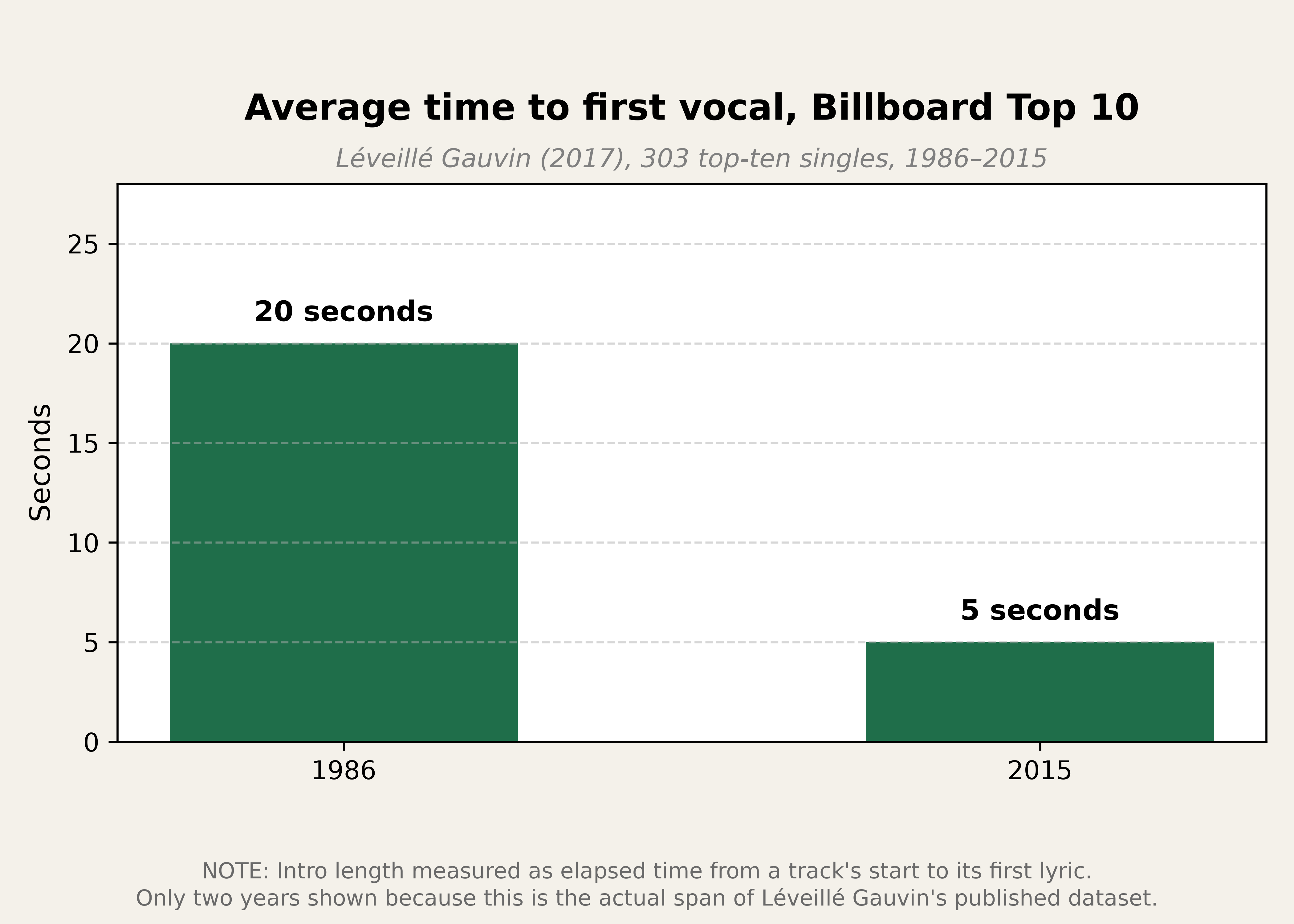
He didn't just find shorter intros, he found the whole opening act had been compressed. Once the vocals started, it took about 18% less time to reach the song's first hook (you'll see this play out in a comparison later in this article). His theory: streaming has turned every song into a pitch that has to land immediately, or the listener has already skipped to something else.
Léveillé Gauvin said, "We're operating in an 'attention economy,' and attention is scarce and valuable."
We see this in everyday life, with ads, TikToks (or IG Reels), and I even think about it when writing my articles.
The competitive environment he's describing is specific: a 2014 analysis of Spotify listening data found that roughly a quarter of streams were abandoned within the first five seconds, and 35% didn't make it past 30. Thirty seconds isn't an arbitrary cutoff either, it's the exact point at which Spotify counts a play as a monetized stream. Below that line, an artist earns nothing, and the algorithm logs a mark against the song.
The TikTok-Shaped Gap in the Data
TikTok is one of the most downloaded apps in the world, and its effect on how songs get discovered and promoted is hard to overstate. But it's a factor Léveillé Gauvin couldn't account for in his study, his data ends in 2015, two years before TikTok launched globally in 2017.
So, dear reader, I did some boots-on-the-ground data analysis of my own, pulling directly from Spotify's API to sketch the shape of what likely happened next, even without a frame-accurate intro measurement and music theory brain like Léveillé Gauvin's.
Songs Did Get Shorter, But They Might Bounce Back
Connecting to Spotify's database through the Spotify for Developers API, I pulled a sample of 28 chart-topping songs with release dates ranging from 1971 to 2026.
| Chart Year | Title | Artist | Duration (seconds) |
|---|---|---|---|
| 1971 | American Pie | Don McLean | 516.893 |
| 1975 | Bohemian Rhapsody | Queen | 355.154 |
| 1977 | Tonight's the Night (Gonna Be Alright) | Rod Stewart | 237.120 |
| 1977 | Hotel California | Eagles | 391.376 |
| 1981 | Bette Davis Eyes | Kim Carnes | 228.000 |
| 1983 | Billie Jean | Michael Jackson | 293.802 |
| ... | ... | ... | ... |
| 2024 | Touch | KATSEYE | 129.882 |
| 2024 | Espresso | Sabrina Carpenter | 175.459 |
| 2025 | Midnight Sun | Zara Larsson | 189.898 |
| 2025 | Sailor Song | Gigi Perez | 211.978 |
| 2026 | Choosin' Texas | Ella Langley | 231.746 |
(Table shortened for readability, the full 28-song dataset is linked in my code source at the bottom of this article.)
70s and 80s songs mostly sit in the 3–6 minute range. By the time we reach 2024, several of the biggest songs have dropped into the low 1:30-2 minute mark, nearly half the runtime of a typical Bohemian Rhapsody-era hit.
Total song length is easier to track at scale than intro timing, so plotting these 28 songs by duration and chart year makes the pattern immediate.
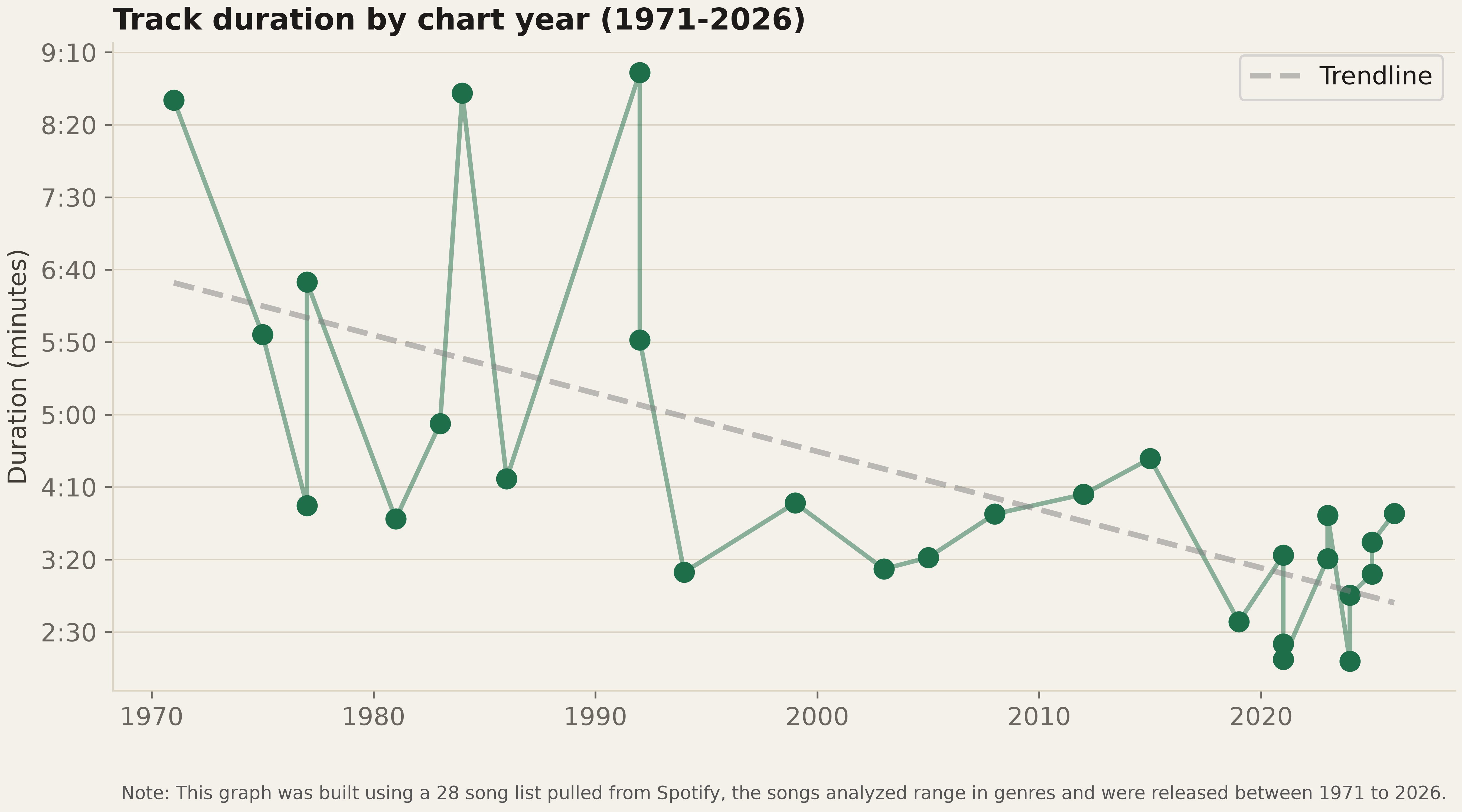
The trend line isn't a straight downward slope, and this is the twist most "songs are dying" takes leave out: song length bottomed out around 3:12 in 2019, but has since climbed back toward the 3:30 mark. Some of the shortest, most TikTok-optimized songs, Dominic Fike's 1-minute-37-second "Babydoll," for instance, now read less like the new normal and more like an overcorrection the market has partly walked back.
Shrinkflation, But Make It Music
Grocery shoppers know the feeling: the cereal box looks the same on the shelf, but it's quietly gotten lighter over the years. Economists call this shrinkflation, the price and the packaging stay put while the actual thing inside gets smaller. Pop music has been doing something similar for about a generation, except nobody printed a smaller net weight on the label.
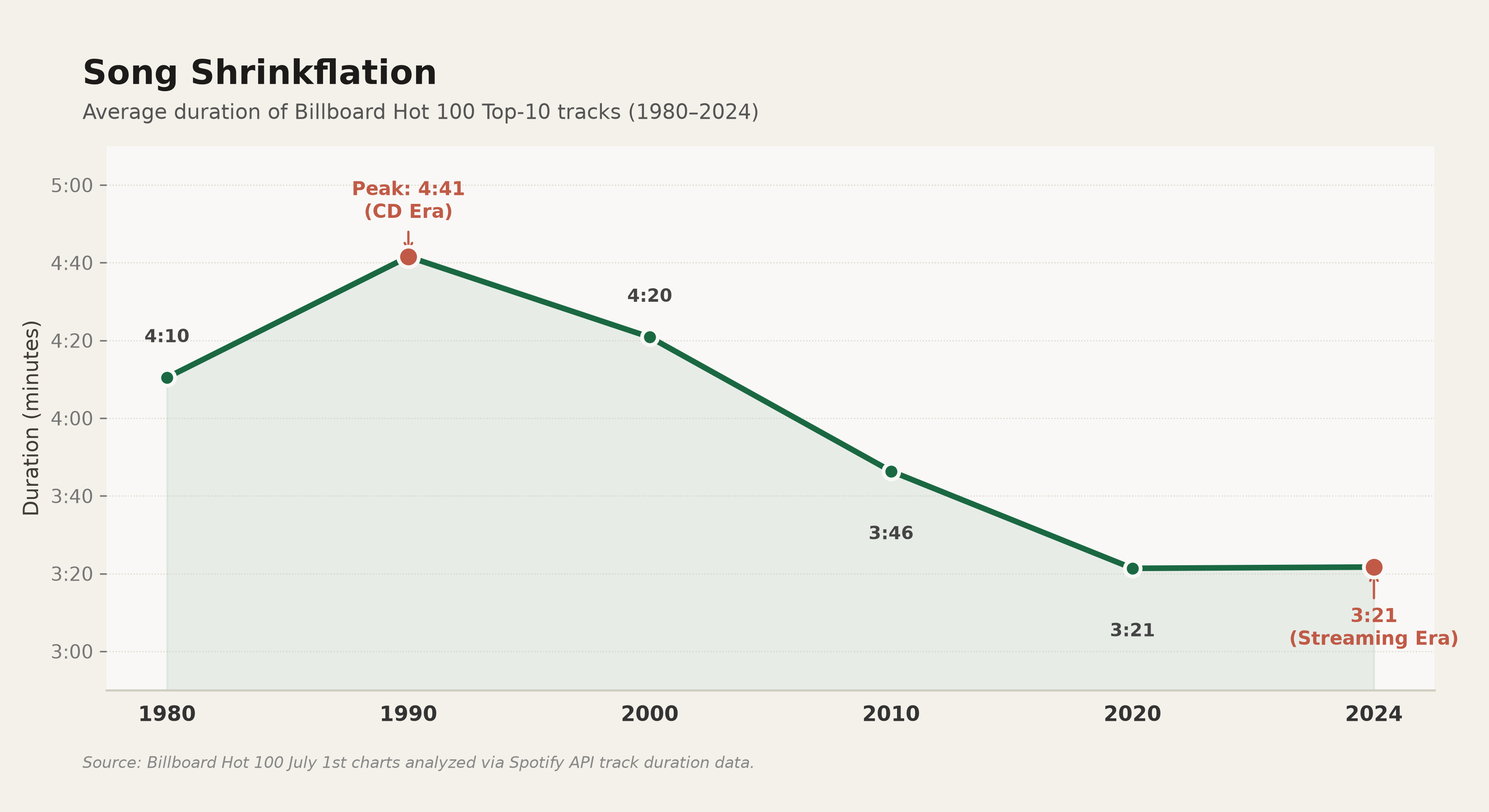
The shrinking doesn't start where you'd expect, though. Running year-over-year averages on Hot 100 top-10 songs, average song length actually grew through the 1980s, peaking at 281.5 seconds in 1990, a reasonable guess is that this tracks with the CD's takeover from vinyl, since a 45 RPM single's roughly four-minutes-per-side limit no longer constrained what could get radio play. The real shrinking starts after that peak: from 1990 to 2024, the average hit lost nearly 80 seconds (28.4% of its length) which is about the length of an entire extra chorus, gone.
What Actually Changed Inside the Songs
Length is a blunt measurement. The more interesting shift is structural. My own recently-played and liked songs on Spotify mostly sit in the 3–5 minute range, there are a few 1–2 minute outliers, but all 4 minutes and 52 seconds of Fergie's "Fergalicious" is a household staple in my library.
When I look at current songs and their lyric breakdowns on Genius, the bridge has largely disappeared from pop hits, and the second verse looks like it's going the same way. Songwriters are compressing a track's whole idea into something that can be pitched in seconds rather than minutes.
TikTok formalized this into an explicit songwriting constraint. Where a conventional pop structure built toward a chorus around the 30-to-60-second mark, TikTok-oriented tracks are now written to open on their catchiest phrase, often within the first three to five seconds, sometimes composed as a 15-second clip first, with the rest of the song built around it afterward. TikTok's own 2024 research, covering 547 tracks, reported that 84% of that year's Billboard Global 200 debuts had gone viral on the platform before they charted. That figure comes from TikTok itself, so it's worth reading as a company describing its own leverage over the charts rather than as independently audited research, but the direction lines up with everything above.
To make this concrete: here's one of my personal favorite songs, Whitney Houston's "I Wanna Dance With Somebody (Who Loves Me)," next to a song that went viral on TikTok (and, for some reason, is also one of my fiancée's favorites), Sabrina Carpenter's "Espresso."
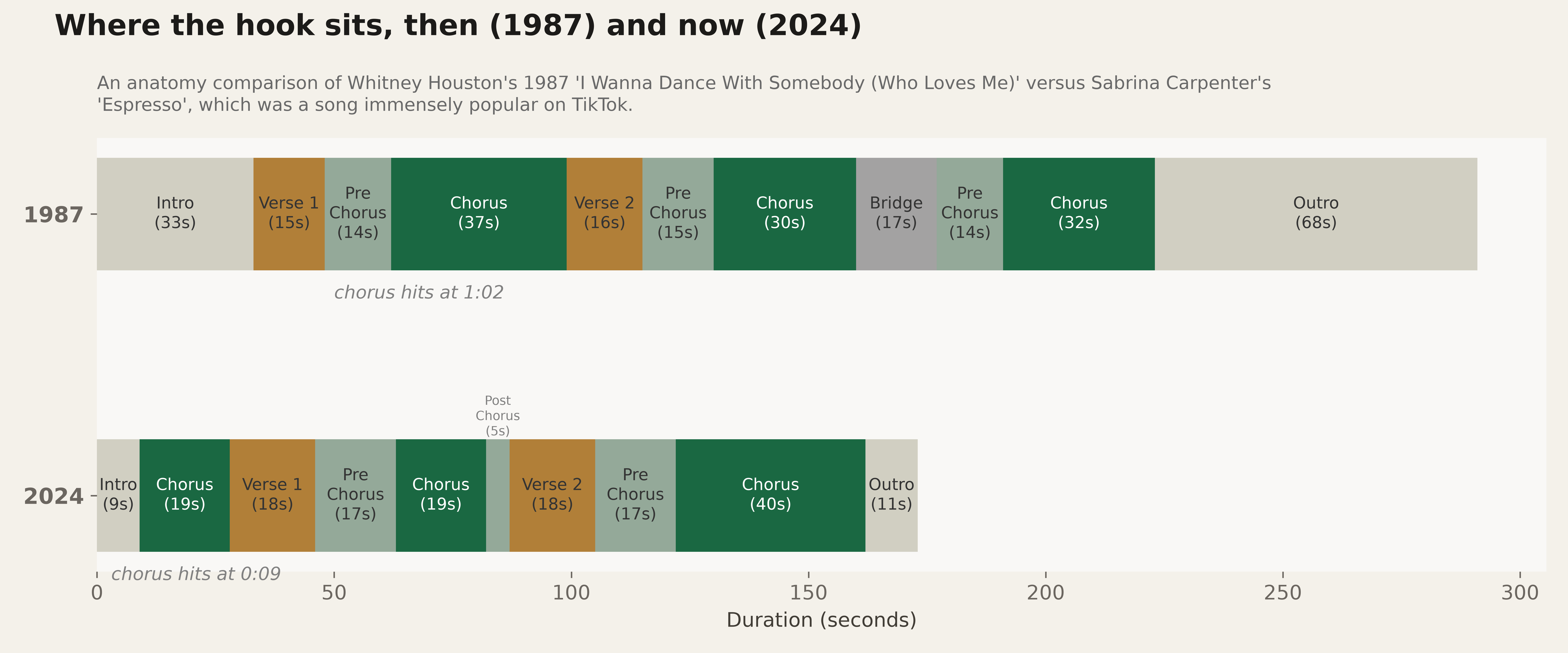
"Espresso" is nearly 40% shorter than "I Wanna Dance With Somebody", its intro is 72.73% shorter, its bridge is functionally nonexistent, and its outro is a whole 83.82% shorter. This is where hit songs are headed now, and the raw numbers back it up:
Sabrina Carpenter's "Espresso" has over 3 billion streams on Spotify, while Whitney Houston's "I Wanna Dance with Somebody (Who Loves Me)" has over 1.7 billion streams on the platform.
What "Skip Rate" Actually Means, and What We Don't Know
Spotify does not publish an industry-wide skip rate, and the platform doesn't expose a single skip-rate number even to artists. Instead, Spotify for Artists shows a listener retention curve, which artists and third-party services then interpret into rule-of-thumb benchmarks. Those benchmarks show up constantly in music-marketing guides: skip rates under roughly 25% in the first 30 seconds are generally described as healthy, above 35% as a warning sign. Those specific thresholds come from marketing and promotion companies, not from Spotify or peer-reviewed research, so I'm treating them as industry folklore rather than hard data, directionally useful, not precise.
The one skip-rate figure with an actual citable source is the older, narrower one already mentioned above: that same 2014 Spotify listening-data study, cited by Léveillé Gauvin, found roughly a quarter of streams abandoned in the first five seconds. I couldn't locate a public, methodologically transparent update to that number for the TikTok era, which is itself worth noting. A lot of what gets repeated as "the skip rate is X%" traces back to promotion companies with an incentive to make the problem sound urgent, not to an independently verifiable dataset.
So, Are Hit Songs Engineered to Hook Us Faster?
The honest answer is: partly, and unevenly. The intro-shrinking trend is real and well-documented through 2015, and every subsequent structural analysis, on song length, bridges, and TikTok-first songwriting, points the same direction. But the length data also shows the trend overshooting and partially correcting itself after 2019, and genres built around patient listening (ambient, jazz, a lot of album-oriented rock) remain largely insulated, because their audiences don't discover music through algorithmic skip decisions in the first place. The skip button didn't rewrite every song. It rewrote the ones that were already competing for a stranger's attention in a feed, which, on Spotify's own charts, is most of them.
Methodology & data footnotes
How this came together
Track metadata (duration_ms, release date) pulled via the Spotify Web API using the Client Credentials flow, cross-referenced against Billboard Hot 100 chart data via the billboard.py package. Year-over-year averages calculated from the top 10 songs on the Hot 100 for the first week of July in each sample year. Full 28-song sample and pull script available at the source link above.
Download the data ↗ Browse the analysis ↗